Engineered wood siding is manufactured by binding wood strands or fibers under heat and pressure with resin, then applying a factory-primed or pre-finished surface. The result is a panel that holds a paint coat longer…
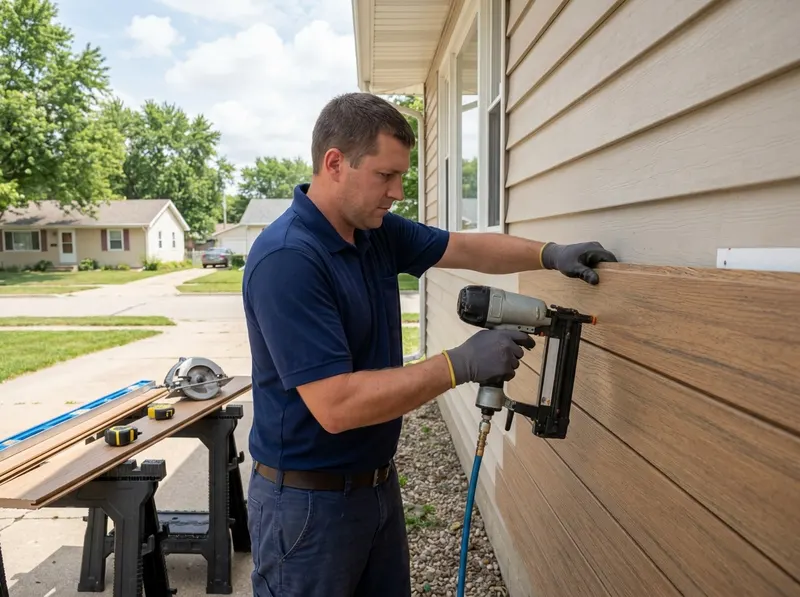
Engineered wood siding is manufactured by binding wood strands or fibers under heat and pressure with resin, then applying a factory-primed or pre-finished surface. The result is a panel that holds a paint coat longer than raw wood, resists the freeze-thaw cycling that Peoria County winters deliver reliably every year, and does not cup or warp the way solid wood does after seasons of moisture swing. Homes in Richwoods and Prospect Heights, many built in the 1960s and 1970s with original aluminum or early vinyl, are well-suited to engineered wood because the profile options include a cedar-texture lap that matches the scale of those older facades without requiring the maintenance that real cedar demands in central Illinois humidity.
The installation sequence matters as much as the product itself. Before a single panel goes up, the project lead inspects the sheathing for soft spots, delamination, or moisture staining, conditions that are common on homes in Glen Hollow and North Valley where roof overhangs are shallow and driving rain off the Illinois River corridor reaches the wall plane. Any compromised sheathing is documented and discussed before work begins, so the scope and cost are locked in writing rather than discovered mid-project. A continuous vapor-permeable housewrap goes on next, lapped and taped at seams according to the manufacturer's installation guide, because the U.S. Department of Energy identifies the wall assembly gap as one of the top five sources of conditioned-air loss in homes of this era. Panels are then fastened at the correct nail spacing specified by the manufacturer, typically 16-inch on-center into studs, with the required gap at the bottom course to prevent wicking. Corner boards, window surrounds, and door casings are installed and back-caulked with a product rated for wood-composite substrates. This sequence is not optional; LP Building Products' installation documentation and James Hardie's technical guides both specify that skipping any step voids the product warranty.
Engineered wood fits a different decision than fiber-cement alone. A homeowner in Kellar Heights or Springdale who wants a wood-grain texture with lower long-term paint maintenance than real cedar, and whose home has a substrate in good shape, is a strong fit for engineered wood lap or panel siding. If the substrate has significant rot or the home has had repeated moisture intrusion near a foundation, a condition sometimes seen in Heading Hills and Alta Terrace due to grade drainage patterns, the inspection may reveal that substrate repair adds to the project timeline and cost, which is addressed honestly in the written proposal rather than buried in a change order later. Engineered wood siding products from manufacturers such as LP SmartSide carry limited warranties in the range of 50 years when installed to spec, but that warranty is only honored when the installation meets the published fastening and clearance requirements, another reason the pre-install inspection and documented process matter. The National Association of Home Builders' study on component life expectancy places properly installed engineered wood siding at 20 to 30 years of service life under typical Midwest conditions, compared to 20 years for vinyl and 15 to 20 years for aluminum.
Homes near Lakeview and Sheridan Village sometimes carry neighborhood association guidelines on exterior finish materials and color ranges. The written proposal from Sealwell Siding Services includes the specific product name, profile, and factory color or primer specification, so homeowners can submit that document directly to any association review process before work begins. Scheduling runs Monday through Saturday; most Peoria-area projects can be started within two to three weeks of a signed proposal, weather permitting. For questions before the on-site visit, call (309) 555-0147 or text a photo of the affected wall for a preliminary read on scope. The National Weather Service Central Illinois forecast office informs scheduling decisions, installation does not proceed in sustained rain or temperatures below the product's published application threshold, typically 40 °F for caulk cure. OSHA scaffolding standards (29 CFR 1926 Subpart Q) govern any elevated work on two-story homes, and compliance is built into the project plan. Waste material from tear-off is handled in accordance with Illinois EPA solid waste guidelines. For homeowners researching material choices independently, the American Wood Council and the Siding and Window Dealers Association publish neutral comparisons of wood-composite products and installation standards that are worth reviewing before any estimate conversation.
Every job gets a firm, written price after a free on-site visit.
For standards, safe disposal, and service guidance on Siding Services in Peoria, IL, useful references include U.S. Dept. of Energy, ENERGY STAR, HUD, OSHA, U.S. Green Building Council, and Google Maps. General consumer and small-business resources are available from USA.gov, Better Business Bureau, FTC Consumer Advice, U.S. Small Business Administration, and Ready.gov.
Tell us about your engineered wood siding installation job in Peoria and we'll send a clear, written quote, usually the same day.
 Sealwell Siding Services